
The 2027 total solar eclipse in Tunisia
On 2 August 2027 the total solar eclipse crosses Tunisia. Totality lasts about 5 minutes 40 seconds in Sfax and about 5 minutes 38 seconds on the Kerkennah Islands, and the path takes in El Jem, Djerba and Gabes. Tunis, the coast towns Sousse, Monastir and Hammamet, Sidi Bou Said and Matmata see only a partial eclipse.
By Iconic Tunisia. Last updated .
Which towns are inside the path
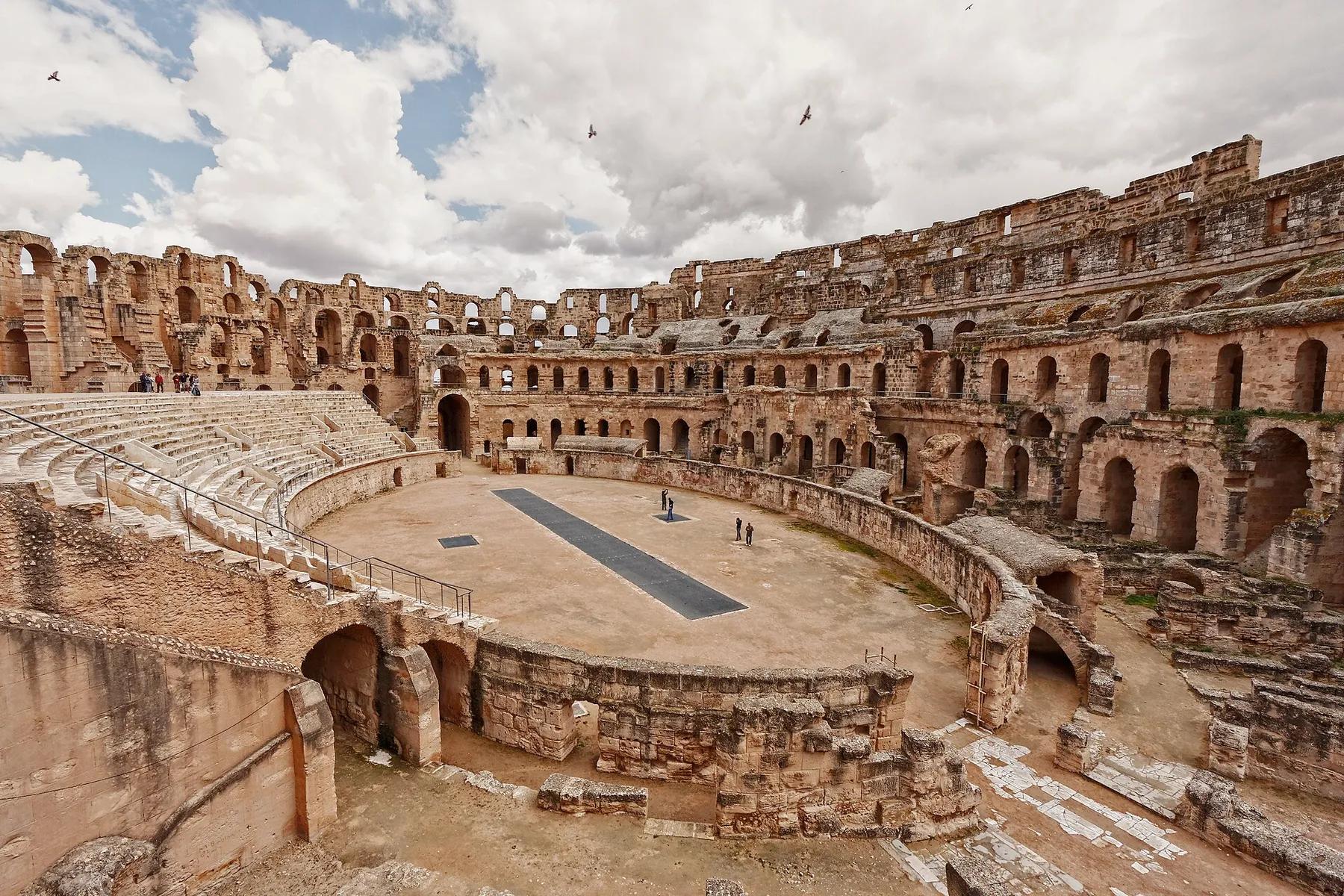
The path of totality crosses Sfax, the Kerkennah Islands, El Jem, Djerba and Gabes. It does not cross Tunis, Sousse, Monastir, Hammamet, Sidi Bou Said or Matmata, which see a partial eclipse only. NASA's own pages list Tunisia among the countries where the eclipse is total (NASA Science), and its path table puts the path 246 to 248 km wide across the country (NASA path table).
NASA publishes the path and the elements that describe it, and no table for a town. The figures below marked "our working" are the result of running NASA's own published calculation, the code behind its eclipse explorer, with the elements on its page for this eclipse. We checked it first at NASA's point of greatest eclipse, in Egypt, where it returns 10:06:38 UT and 6 minutes 22.5 seconds against NASA's published 10:06:37.7 UT and 6 minutes 22.6 seconds. These are our figures and not NASA's, and where a published figure exists we print it beside ours.
Places inside the path
| Place | Totality begins | Totality ends | Duration, our working | Published, Spain Solar Eclipse |
|---|---|---|---|---|
| Sfax | 10:08 | 10:14 | 5 min 40 s | 5 min 39 s |
| Kerkennah Islands (Remla) | 10:09 | 10:15 | 5 min 38 s | 5 min 39 s |
| Sidi Bouzid | 10:06 | 10:12 | 5 min 31 s | Not published |
| Kasserine | 10:05 | 10:10 | 5 min 27 s | Not published |
| Sbeitla | 10:05 | 10:11 | 5 min 18 s | 5 min 16 s |
| Gafsa | 10:05 | 10:10 | 5 min 08 s | Not published |
| Djerba (Houmt El Souk) | 10:09 | 10:14 | 4 min 38 s | 4 min 42 s |
| Tamerza | 10:04 | 10:09 | 4 min 37 s | Not published |
| El Jem | 10:09 | 10:13 | 4 min 24 s | 4 min 23 s |
| Gabes | 10:08 | 10:12 | 4 min 06 s | 4 min 06 s |
| Maguer Gorge, a Star Wars site (Galaxy Tours GPS) | 10:05 | 10:09 | 3 min 09 s | Not published |
| Zarzis | 10:11 | 10:14 | 2 min 51 s | 2 min 53 s |
| Mahdia | 10:10 | 10:13 | 2 min 50 s | 2 min 48 s |
| Kairouan | 10:08 | 10:11 | 2 min 44 s | 2 min 41 s |
| Ong Jemel, a Star Wars site (Galaxy Tours GPS) | 10:05 | 10:08 | 2 min 29 s | Not published |
| Mos Espa large set, a Star Wars site (Galaxy Tours GPS) | 10:05 | 10:07 | 2 min 08 s | Not published |
| Tozeur | 10:06 | 10:08 | 1 min 39 s | 1 min 46 s |
Times are Tunisian time, which is UTC+1 all year with no daylight saving (timeanddate), cut to the minute as the published tables print them. Coordinates are Wikipedia's for the towns, except Sfax, which is NASA's own city list, and Galaxy Tours' GPS for the three Star Wars sites and Maguer Gorge, so those are approximate. Published figures are Spain Solar Eclipse's. Close to the edge of the path, a few kilometres change the duration by many seconds, which is why Tozeur is 1 min 39 s on our working and 1 min 46 s published. Treat a duration near the edge as approximate.
The Mos Espa set, Ong Jemel and Maguer Gorge are inside the path on these coordinates, with about two to three minutes of totality. The sites around them are not, as the next table shows. Which sites are which, and what was filmed at each, is in Star Wars filming locations in Tunisia.
Places outside the path
A place outside the path sees a partial eclipse, however close to the edge it is. The fraction of the Sun's diameter covered at the maximum is the eclipse magnitude, and below 1.0000 the Sun is never fully covered. Some sources print instead the share of the Sun's disc that is covered, which is the share of its area and not of its width, and which reads a little higher for the same place.
| Place | Fraction of the Sun's diameter covered, our working | Share of the disc covered, Spain Solar Eclipse |
|---|---|---|
| Nefta | 0.9993 | Not published |
| Hotel Sidi Driss, Matmata | 0.9992 | 99.99 percent |
| Gour Beni Mzab, a Star Wars site (Galaxy Tours GPS) | 0.9983 | Not published |
| Monastir | 0.9975 | 99.93 percent |
| Lars homestead dome, Chott el Djerid, a Star Wars site (Galaxy Tours GPS) | 0.9974 | Not published |
| Sousse | 0.9965 | 99.88 percent |
| Medenine | 0.9962 | 99.85 percent |
| Douz | 0.9909 | 99.51 percent |
| Ksar Haddada, a Star Wars site (Galaxy Tours GPS) | 0.9865 | Not published |
| Dougga | 0.9845 | Not published |
| Tataouine | 0.9817 | 98.69 percent |
| Hammamet (approximate coordinates) | 0.9778 | 98.26 percent |
| Ksar Ouled Soltane, disputed as a Star Wars site | 0.9774 | Not published |
| Tabarka | 0.9690 | Not published |
| Tunis | 0.9667 | 97.07 percent |
| Sidi Bou Said | 0.9636 | Not published |
Our working, with the same coordinates as above. The share of the disc is as Spain Solar Eclipse publishes it. Hammamet's coordinates are approximate and not from a source. Even 99.93 percent of the disc, which is Monastir's figure, is not totality.
Nefta, the Hotel Sidi Driss at Matmata, the Lars homestead dome and Gour Beni Mzab are all outside the path, at magnitudes from 0.9974 to 0.9993. With margins this small, a few kilometres can settle it, so if you are coming for totality, ask us about any place that is not in these tables.
How long totality lasts, source by source
Published durations for Sfax and Kerkennah run from 5 minutes 38 seconds up to about 5 minutes 45 seconds. None of them is wrong. They answer slightly different questions.
| Source | Place | Totality | Why the figure is what it is |
|---|---|---|---|
| Our working with NASA's elements | Sfax, Kerkennah | 5 min 40 s, 5 min 38 s | NASA's calculation and the elements on its page for this eclipse, at the town. Delta T 71.7 seconds. A second run with the elements bundled in NASA's explorer, delta T 76.0 seconds, differs by under a second |
| Spain Solar Eclipse | Sfax, Kerkennah | 5 min 39 s, 5 min 39 s | JPL's DE440s ephemeris. Totality at Sfax from 10:08:50 to 10:14:29 |
| timeanddate | Sfax | 5 min 41 s | The page states a delta T of 0 seconds and timings accurate to within a few seconds. Its magnitude of 1.032 is a different definition |
| Orbital Radar | Sfax | 5 min 43 s | Says it is cross checked against NASA data. Its totality runs from 10:08 to 10:14 |
| Space.com | Kerkennah | 5 min 43 s | Its "10:09 CET" matches the start of totality at Kerkennah, not the maximum |
| NASA's path table, centre line | On the centre line near Kerkennah | 5 min 44.8 s | The centre line is some 15 to 30 km farther south than those two places, and totality lasts longer on the line than in a town |
Three things cause the spread. The sources choose different observing points: a town centre, or the centre line of the path, which runs some 15 to 30 km farther south than those two places. They use different values of delta T, the difference between Terrestrial Time and Universal Time: 71.7 seconds on NASA's page for this eclipse, 72.8 seconds on EclipseWise, 76.0 seconds in NASA's explorer and 0 seconds on timeanddate. And they model the edge of the Moon slightly differently.
What time it is
Tunisia is on UTC+1 all year. On our working, totality starts between about 10:05 and 10:12 in the morning anywhere in the country, and the Sun stands 53 to 57 degrees above the horizon.
| Event | Sfax | Kerkennah | Who prints it |
|---|---|---|---|
| Partial eclipse begins | 08:56 | 08:56 | timeanddate and Orbital Radar print 08:56 for Sfax |
| Totality begins | 10:08 | 10:09 | Orbital Radar prints 10:08 for Sfax. Space.com's 10:09 CET is this event at Kerkennah |
| Maximum | 10:11 | 10:12 | timeanddate and Orbital Radar print 10:11 for Sfax. Most sources quote this event |
| Totality ends | 10:14 | 10:15 | Orbital Radar prints 10:14 for Sfax |
| Partial eclipse ends | 11:31 | 11:32 | timeanddate and Orbital Radar print 11:31 for Sfax |
Our working at Sfax and Kerkennah, from NASA's elements, cut to the minute. The sources named print the events listed.
The spread of published times comes from three things that are easy to mix up.
- Different events. Space.com's "10:09 CET" at Kerkennah matches the start of totality there. Most other sources quote the maximum, 10:11 to 10:12. Neither is wrong. They are different events.
- Two kinds of time. NASA lists the greatest eclipse at 10:07:49.4 Terrestrial Dynamical Time, which is 10:06:37.7 UT. EclipseWise writes "10:07:50 TD (10:06:37 UT1)". Quoting the first as though it were a clock time overstates it by about 72 seconds.
- Different places. A time or a duration worked out on the centre line of the path and one worked out for a town are not the same figure, because they are different places.
NASA's own centre line across the country, with the Tunisian time beside NASA's Universal Time:
| Universal Time | Tunisian time (UTC+1) | Centre line | Width of the path | Totality on the line |
|---|---|---|---|---|
| 09:06 | 10:06 | 35 deg 04.4 min N, 007 deg 33.3 min E | 246 km | 5 min 34.3 s |
| 09:08 | 10:08 | 34 deg 54.3 min N, 008 deg 43.5 min E | 246 km | 5 min 38.0 s |
| 09:10 | 10:10 | 34 deg 43.4 min N, 009 deg 51.5 min E | 247 km | 5 min 41.5 s |
| 09:12 | 10:12 | 34 deg 31.6 min N, 010 deg 57.6 min E | 248 km | 5 min 44.8 s |
| 09:14 | 10:14 | 34 deg 19.1 min N, 012 deg 01.9 min E | 248 km | 5 min 48.0 s |
From the NASA path table. The centre line passes near Kasserine and Sidi Bouzid, and then just south of Sfax and Kerkennah, on our reading of the coordinates. The greatest eclipse of all is in Egypt, with 6 minutes 22.6 seconds on NASA's page, and the greatest duration, 6 minutes 23.2 seconds, is also in Egypt.
Where sources disagree
- Durations. 5 min 38 s to about 5 min 45 s, as above, and for the reasons above.
- Whether Tunisia is on the list. EclipseWise's summary page lists the regions where the eclipse is total as Morocco, Spain, Algeria, Libya, Egypt, Saudi Arabia, Yemen and Somalia, and leaves Tunisia out (EclipseWise). NASA's pages include Tunisia and its path table crosses the country.
- One outlier. A search excerpt of another site put totality at Sfax about 85 minutes after every other source and our working. We did not open the page and we treat it as an error.
Weather
It is midsummer. In August the weather service's average daytime high is 102.7F (39.3C) at Tozeur and 92.3F (33.5C) on Djerba. The Kairouan station, the closest to El Jem, reads 99.5F (37.5C). Its table has no station for Sfax or Kerkennah (Institut National de la Météorologie).
Cloud is a separate question, and two published statistics speak to it. They are not forecasts, and they do not measure the same thing, so they cannot be compared. Space.com puts the chance of cloud on Kerkennah at 21 percent. timeanddate records that day as cloudy for 2 percent of the time at Sfax since 2000.
Watching safely
NASA says you can look at the eclipse without eye protection only during totality, when the Moon completely obscures the Sun's bright face. During the partial phases before and after totality, eclipse glasses or a solar viewer must stay on, and they ought to comply with the international standard ISO 12312-2. Regular sunglasses, no matter how dark, are not safe for viewing the Sun (NASA Science).
The trip
For the trip built around the path, see our eclipse expedition page. We confirm availability on the call.
What we could not verify
- A static NASA table for Sfax or Kerkennah. None exists. The figures marked "our working" are the result of NASA's own calculation and are not published by NASA.
- What NASA's explorer prints for Sfax in a browser. Our run uses the same code and elements, so it should agree to within seconds.
- The coordinates each third party site used, which is part of why their figures differ.
Questions and answers
- When is the total solar eclipse in Tunisia, and at what time?
- Monday 2 August 2027. At Sfax totality begins at about 10:08 in the morning, Tunisian time (UTC+1), and ends at about 10:14. On Kerkennah it runs from about 10:09 to 10:15. These are our working from NASA's elements, cut to the minute. Published times differ because sources print different events or use different assumptions.
- How long does totality last in Tunisia?
- By our working from NASA's data, 5 minutes 40 seconds in Sfax and 5 minutes 38 seconds on Kerkennah. Published figures run from 5 minutes 38 seconds up to about 5 minutes 45 seconds, because sources work from different points, such as a town or the centre line of the path, which is some 15 to 30 km farther south, and use different values of delta T.
- Which Tunisian cities are in the path of totality?
- Gabes, Djerba, El Jem, Sfax and the Kerkennah Islands, and also Kasserine, Sidi Bouzid, Sbeitla, Gafsa, Mahdia, Zarzis and Kairouan, with totality from about 5 minutes 30 seconds at Sidi Bouzid to under three minutes at Kairouan. Tozeur only just makes it, with under two minutes. The path is 246 to 248 km wide across Tunisia.
- Is Tunis in the path of totality?
- No. Tunis is outside the path, as are Sousse, Monastir, Hammamet, Sidi Bou Said and Matmata, and each sees a partial eclipse. Spain Solar Eclipse puts the share of the Sun's disc covered at 97.07 percent in Tunis and 99.93 percent in Monastir, and neither is totality.
- Is it safe to look at the eclipse?
- NASA says you can look without eye protection only during totality, when the Moon completely obscures the Sun's bright face. Before and after it, use eclipse glasses or a solar viewer that complies with ISO 12312-2. Regular sunglasses, no matter how dark, are not safe for viewing the Sun.
- What is the chance of cloud on 2 August in Tunisia?
- Two published statistics, which measure different things and are not forecasts. Space.com puts the chance of cloud on Kerkennah at 21 percent, and timeanddate's records since 2000 show that day cloudy for 2 percent of the time at Sfax.
Sources
Every figure in this guide names where it came from. These are the sources, in the order the guide first uses them. Where a figure is our own working on a source's numbers, the guide says so beside it. Figures about our own programmes, the prices, the itineraries, the hotels and the months we suggest, come from the programme documents behind each journey page.
- NASA Science, future eclipses
Official.
- NASA path table for the total solar eclipse of 2 August 2027
NASA Goddard Space Flight Center. Official.
- NASA JavaScript Solar Eclipse Explorer
NASA Goddard Space Flight Center. Official.
- NASA Besselian elements for the same eclipse
NASA Goddard Space Flight Center. Official.
- timeanddate, the eclipse at Sfax
timeanddate.com. Published.
- Spain Solar Eclipse, Tunisia
Published.
- EclipseWise, total solar eclipse of 2027 August 2
Published.
- Institut National de la Météorologie, climate data
Official.
- Space.com, the best places to see the 2027 total solar eclipse
Published.
- NASA Science, eclipse viewing safety
Official.
- Orbital Radar, the eclipse at Sfax
Published.
Written by Iconic Tunisia and last checked against these sources on 11 October 2026. Nothing here is legal, medical or insurance advice.
Where to go from here
The total solar eclipse
The expedition page is the trip built around the path: where to be that morning, and how to start planning it.
Starting takes two minutes. We ask for your rough dates, who is travelling and where to reply, and nothing about payment or passports.
We reply within one business day, US Eastern time.