
Carthage
Carthage is the ancient Phoenician city on the Gulf of Tunis that Rome destroyed in 146 BC and then rebuilt as the capital of Africa Proconsularis. UNESCO inscribed the archaeological site in 1979. The Antonine Baths, Byrsa Hill and the Punic ports are the main things to see.
- Time on our journeys
- Half a day
- Region
- Tunis and Carthage
- UNESCO World Heritage
- Inscribed in 1979 as the Archaeological Site of Carthage.
- On our journeys
- Six of our six private journeys
Visiting Carthage
Carthage was founded around 814 BC by Phoenician colonists and grew into a maritime empire and a major commercial hub. It fought Rome in the Punic Wars, the Second of them led by Hannibal, and Rome destroyed it in 146 BC at the end of the Third. The Romans then rebuilt the city, and it became the capital of the province of Africa Proconsularis. Hannon the navigator and Magon the agronomist were Carthaginians too.
The archaeological remains are extensive and diverse, on a hill that dominates the Gulf of Tunis and the plain behind it. On the Roman side are the Antonine Baths, among the largest Roman bath complexes in Africa, the amphitheatre, the theatre where the Carthage international festival is held, and the villas and houses that show Roman urban living. On the Punic side are Byrsa Hill, the ancient citadel and the heart of Punic Carthage, later redeveloped by the Romans; the remains of the Punic ports, military and commercial; and the Tophet, a Punic burial ground. The Carthage National Museum is on the hill as well.
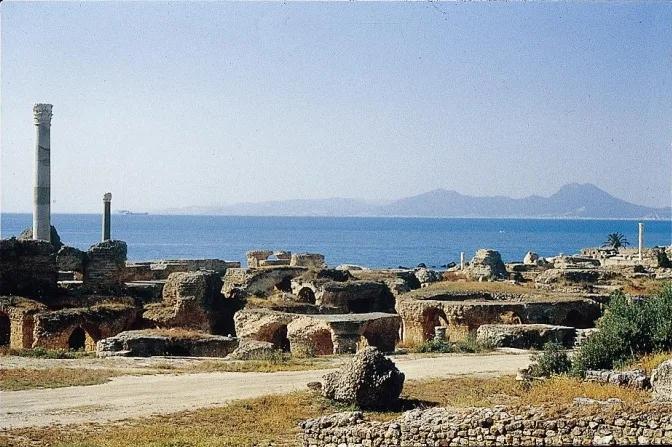
On our programmes Carthage is the morning of the second day, after the first night in Tunis. The sheets picture the view of the Bay of Tunis from the Antonine Baths. On the eleven day journey the visit leaves ample time for the US war cemetery. On several programmes the welcome dinner on the first evening is held here or in La Goulette.
What to see
- The Antonine Baths, among the largest Roman bath complexes in Africa
- Byrsa Hill, the citadel of Punic Carthage
- The Punic ports, military and commercial
- The Tophet, a Punic burial ground
- The Roman amphitheatre
- The Roman theatre, home of the Carthage international festival
- The Carthage National Museum
- The Roman villas and houses
Journeys that include Carthage
Six of our seven journeys visit Carthage. The day by day, the hotels and the price are on each journey's own page.
- Carthage, Kairouan and the Coast7 days, 6 nights. Reached on day 2.$1,950 a person, double occupancy
- From Carthage to Kairouan7 days, 6 nights. Reached on day 2.$2,190 a person, double occupancy
- The Splendors of Tunisia8 days, 7 nights. Reached on day 2.$2,190 a person, double occupancy
- Tunisia's Marvels10 days, 9 nights. Reached on day 2.$2,550 a person, double occupancy
- The Wonders of Tunisia11 days, 10 nights. Reached on day 2.$3,150 a person, double occupancy
- Tunisia's Mediterranean Treasures12 days, 11 nights. Reached on day 2.$3,690 a person, double occupancy
Along the way in Tunis and Carthage
The capital, the Punic and Roman ruins on the gulf, and the blue and white village above them.
Start with Carthage.
Tell us it belongs on your route and we shape the rest around your dates. We reply within one business day, US Eastern time. After a twenty minute call, a day by day proposal follows within 48 hours, with the hotels named and a firm price per person.
Starting takes two minutes. We ask for your rough dates, who is travelling and where to reply, and nothing about payment or passports.
Straight to our team in Tunisia.
Your dates, your pace and the budget, in twenty minutes.
The planning guide is free, and it asks for an email address and nothing else. It covers safety in plain terms, when to go, what it costs, getting there from the United States and one sample itinerary.
We reply within one business day, US Eastern time.